

Eritrea. Liberty Magazine Issue Nr.84
Tuesday, 02 July 2024 09:03 Written by EPDP Foreign Office AffairsEven supporters are fleeing the regime: The Eritrean ambassador has applied for asylum in Switzerland
Thursday, 13 June 2024 23:12 Written by Martin PlautThe new ambassador to Switzerland visited all the cantons and collected a lot of money, according to the news report on Eri-TV. It meticulously lists how much money was collected in each of the cantons during this Tour de Suisse. 9127 francs in Lucerne, 6481 francs in Aarau and 4910 francs in St. Gallen - in total, Zerai is said to have collected over 50,000 francs for the state treasury in twelve cantons. The fact that he made it into the TV news shows one thing above all: how tight the regime is and how urgently those in power need foreign currency from abroad.
Eritrea.Liberty Magazine Issue Nr.83
Tuesday, 02 April 2024 20:52 Written by EPDP Foreign Office AffairsNorwegian parties send plan to end transnational repression of Eritreans to Parliament
Wednesday, 13 March 2024 23:24 Written by Martin Plaut
|


Eritrean refugees fleeing to Ethiopia are being ransomed and tortured in Tigray – report
Wednesday, 28 February 2024 19:13 Written by Martin Plaut|
|
Martin Plaut posted: " The report below by Human Rights Concern - Eritrea has been strengthened by information from other sources: This has been going on for a year or longer, once armed conflict abated in Tigray; Destitution in Tigray leads to the participation by " Martin Plaut |
The report below by Human Rights Concern - Eritrea has been strengthened by information from other sources: · This has been going on for a year or longer, once armed conflict abated in Tigray; · Destitution in Tigray leads to the participation by perpetrators; · There are thousands of victims; · Who is perpetrating these crimes has not been identified -- Tigrayans? Are Tigray authorities involved? Eritrean operatives? Amharas, etc.? We have heard that Eritrean smugglers in Eritrea have encouraged or facilitated future victims to move south to Tigray; · The scheme seems to be highly organized. Urgent Appeal: Eritrean Refugees Held for Ransom in Tigray, Ethiopia15 February 2024 Eritreans escaping their homeland’s oppressive regime and seeking refuge in Ethiopia’s Tigray region are falling victim to kidnappings for ransom. Disturbingly, the perpetrators are not only demanding payment from the victims' families but are also reselling the individuals to other criminals, perpetuating a distressing cycle of extortion. Reports indicate that Eritrean refugees, already vulnerable and fleeing dire circumstances, are subjected to torture while pleading with their relatives over the phone. The number of abducted Eritreans is rapidly increasing, and family members are being compelled to pay amounts ranging from $4,500 to $5,000 US dollars per person. Shockingly, even after ransom payments are made, victims are not released, instead, they are resold, to other kidnappers, members of criminal gangs who demand the same amount of ransom. This highlights the severity of this organized criminal activity. Funds are collected through various means, including cash and bank transfers in both Tigray and the Ethiopian capital, Addis Ababa. This egregious crime against defenceless Eritrean refugees is known to the authorities in Tigray, yet thus far, no substantial actions have been taken to halt it. The severity of this situation demands immediate attention and concerted efforts involving both the authorities in Tigray and the Ethiopian government to eliminate such inhumane practices. Human Rights Concern Eritrea (HRCE) urgently calls on the regional government of Tigray and the government of Ethiopia to: · Launch a prompt and thorough investigation into these heinous crimes, pursuing all leads related to the criminal gangs involved; · Ensure security and protection for all refugees in the region; · Collaborate with international organisations to establish a coordinated effort in investigating and dismantling the criminal networks involved in the kidnapping and extortion of Eritrean refugees; · Enhance border security to prevent the illegal trafficking and movement of victims across borders, hindering the criminals' ability to exploit regional vulnerabilities; · Strengthen the legal framework and law enforcement capabilities to prosecute individuals involved in human trafficking, kidnapping, and extortion, ensuring that justice is served and perpetrators are held accountable. HRCE also appeals to the United Nations, African Union, and International Human Rights organisations to: · Conduct a thorough investigation into all reported cases of Eritrean kidnappings for ransom in Tigray; · Engage with the regional government of Tigray and the government of Ethiopia, urging swift action to end these crimes and apprehend the perpetrators; · Strongly demand that Tigray Regional security services and police provide protection to Eritrean refugees; · Advocate for the establishment of an international task force to investigate and address the transnational aspects of the criminal networks involved in the kidnapping and extortion of Eritrean refugees; · Engage with regional and international partners to provide financial and logistical support to enhance the capacity of local authorities in Tigray to combat human trafficking and protect vulnerable populations; · Monitor and report on the progress made by the regional government of Tigray and the Ethiopian government in addressing the issue, ensuring transparency and accountability in their efforts; · Raise awareness globally about the plight of Eritrean refugees in Tigray, emphasizing the need for a sustained international response to address the ongoing challenges faced by these vulnerable populations. Human Rights Concern - Eritrea (HRCE) This email address is being protected from spambots. You need JavaScript enabled to view it.+44 7958 005 637 |
|
|
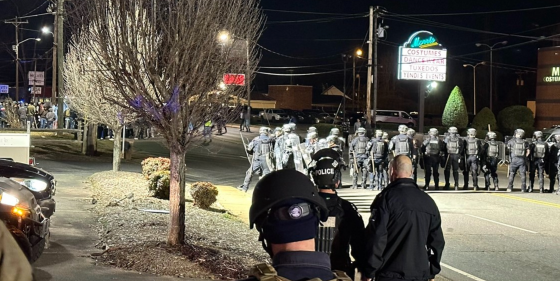
Several people arrested, tractor-trailer lit aflame during protest against Eritrean government supporters, Charlotte police sayCMPD said the protest had civil rights issues at the core. Protesters dispersed around 9:30 p.m. Saturday. Author: Matthew Ablon (WCNC) Published: 3:44 PM EST February 17, 2024
CHARLOTTE, N.C. — A protest that closed off a section of a Charlotte street Saturday resulted in several arrests, and it was centered on global human rights issues in another country. The Charlotte-Mecklenburg Police Department confirmed in a post to X the protest was being held on private property on Monroe Road. Officers said up to 200 people were present in what was described as a civil rights protest regarding a cultural festival. A CNC Charlotte crew notes some protesters were standing outside the Morris Costumes shop earlier in the afternoon. For the latest breaking news, weather and traffic alerts, download the WCNC Charlotte mobile app and enable push notifications. CMPD deemed the protest as unlawful since it happened on private property and that Morris Road was closed down from McAlway Drive to Alliance Drive. Officers said protesters have been told to leave and that anyone remaining could be subject to arrest. The department later said officers used pepper spray shortly after 3 p.m. to get protestors out of the street. CMPD said the spray hit some protestors as well as some officers who were treated on the scene. Around 4 p.m., CMPD said officers had arrested four people. Less than an hour later, the inbound lanes of Monroe Road had been reopened. The gathering was still ongoing, however. Later in the evening, CMPD said three men were charged with impeding traffic, while a woman was charged with impeding traffic, citing a riot, and assault on a government official. She reportedly also had a firearm seized from her. CMPD also said another firearm was seized and that three further protestors were arrested. Dispersal orders were given again as the department said the protesters were blocking the entrance to the business hosting the event. Just after 7:30 p.m., CMPD said its Civil Emergency Unit was activated, but it was reportedly met with aggression from crowds. The department said it was working to contain the scene. Around 8:15 p.m., police said crowds had set a tractor-trailer on fire, which was quickly doused by the Charlotte Fire Department. Another person was also arrested, bringing the total to eight. The department later said officers used pepper spray shortly after 3 p.m. to get protestors out of the street. CMPD said the spray hit some protestors as well as some officers who were treated on the scene. Around 4 p.m., CMPD said officers had arrested four people. Less than an hour later, the inbound lanes of Monroe Road had been reopened. The gathering was still ongoing, however. Later in the evening, CMPD said three men were charged with impeding traffic, while a woman was charged with impeding traffic, citing a riot, and assault on a government official. She reportedly also had a firearm seized from her. CMPD also said another firearm was seized and that three further protestors were arrested. Dispersal orders were given again as the department said the protesters were blocking the entrance to the business hosting the event. Just after 7:30 p.m., CMPD said its Civil Emergency Unit was activated, but it was reportedly met with aggression from crowds. The department said it was working to contain the scene. CMPD would later share that around 9:30 p.m. the protesters dispersed and that officers were clearing the scene. A press conference was held shortly after where more details were shared. Officers said they were called to a business around noon because a group of people were blocking the entrance to it to try and prevent an event from happening. While the group of people putting on the event was eventually able to get in side, the protesting group remained outside for several hours. CMPD said some protesters threw things like sticks and bottles at officers as well. Eventually, CMPD was able to negotiate with both the group hosting the event and the protesters. The event group was able to leave and protesters eventually dispersed. During the news briefing Saturday evening, CMPD said they were unaware beforehand that a protest had been planned nor were they in the loop about the event. A spokesperson said they had made contacts during the incident both with protesters and the group hosting the event and would be doing follow-up work. Vinroy Reid, who owns a business near the scene, told WCNC Charlotte the scene involved two groups of people. The group hosting the event was apparently supportive of the current Eritrean government, while the protesters were opposed. Eritrea is located in eastern Africa, south of Saudi Arabia and on the Red Sea. The current president is Isaias Afwerki, who has held office since 1993. Afwerki's government has been accused of human rights abuses in the past by non-governmental organizations such as Human Rights Watch, who in 2023 said the Eritrean government represses citizens by imposing restrictions on freedom of expression, opinion, and faith, among others. HRW notes Afwerki closed all independent newspapers in 2001 and arrested 10 journalists who, as of 2023, have been held incommunicado. HRW also reports that elections have not been held since Afwerki assumed the presidency in 1993, when Eritrea also gained independence from Ethiopia. |
Probe into Eritrean riots “should not let regime off the hook”
Wednesday, 28 February 2024 18:21 Written by Menasmer|
|
“Violence is never acceptable and can never be condoned,” Van Reisen told Dutch News. “Having said that, Brigade Nhamedu is very concerned about the fact that the long arm of the Eritrean government is given so much leeway and in some cases enjoys official protection, while it is impinging on their freedom.” February 21, 2024 Gordon Darroch Source: Dutch News
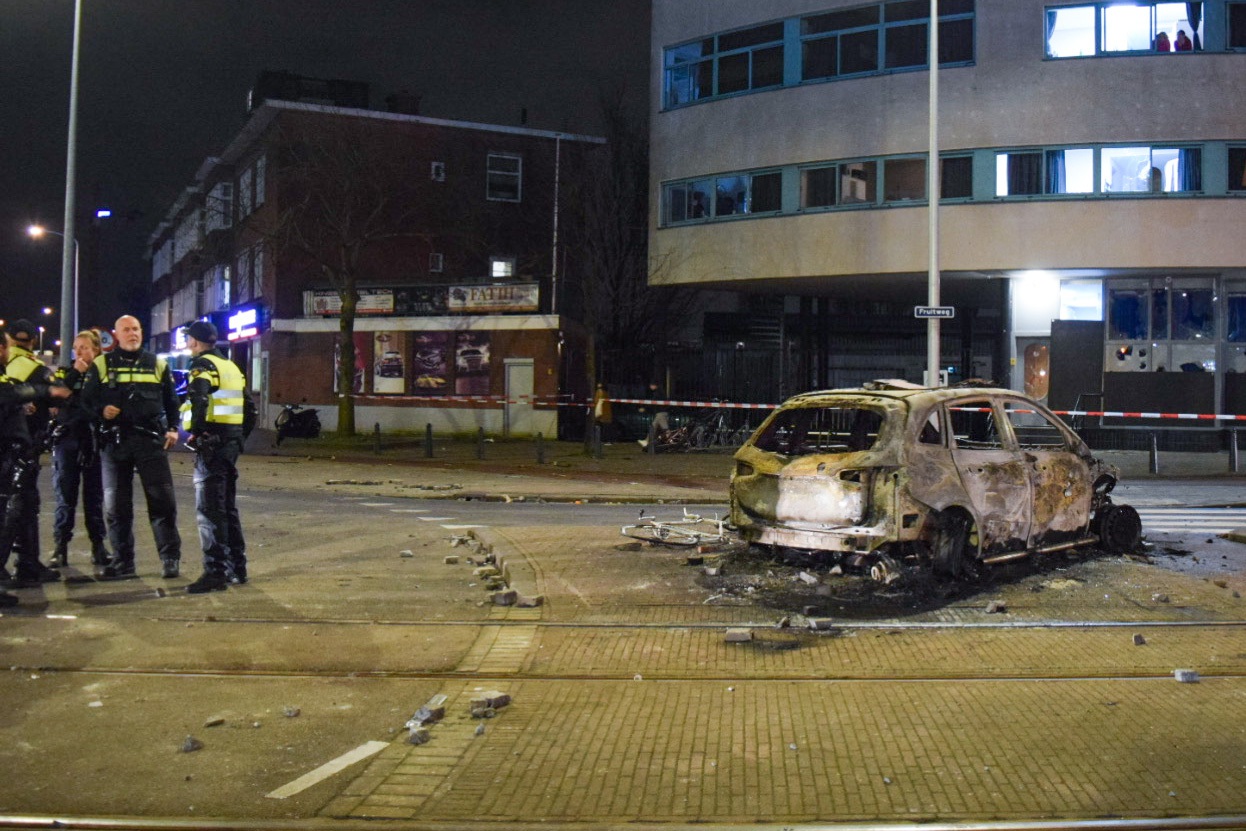
Police officers standing by a burned-out car on Fruitweg in The Hague after the riots. Photo: Mouneb Taim/Anadolu via ANP An investigation into the riots that erupted at an Eritrean festival in The Hague at the weekend should examine the role of Eritrea’s government as well as opposition groups, politicians and academics have said. On Wednesday the prosecution service said a 28-year-old man had been arrested on Friday, the day before the riots, for posting a video calling on people to attack the gathering at the Opera venue on Fruitweg. Thirteen people aged between 19 and 36 have so far been arrested in the wake of the riots on Saturday evening, in which police and firefighters were pelted with stones and police cars and a coach were set on fire. Fifteen officers were injured. The Hague’s mayor, Jan van Zanen, blamed a group opposed to the Eritrean regime, Brigade Nhamedu, for orchestrating the violence, which he called “appalling and unacceptable”. Van Zanen issued an emergency order early on Saturday restricting access to the venue after receiving indications that opposition activists were planning to disrupt the gathering, but acknowledged afterwards that “signs were missed”. Politicians have called for an investigation into Brigade Nhamedu’s activities, with some, such as the far-right PVV, calling for those responsible for the violence to be deported immediately. Eritrea’s government has also condemned the violence and refuted any suggestions it was indirectly responsible. Negassi Kassa Tekle, the country’s ambassador to Belgium who also serves the community in the Netherlands,told Nieuwsuur: “This is not a political issue. This is a lawless group of people merely focusing on the disruption and obstruction of Eritrean gatherings.” But Mirjam van Reisen, professor of international relations at Tilburg University, who specialises in human rights in Eritrea, said tensions within the community had increased in recent years as the government tried to exert control through cultural events. “Violence is never acceptable and can never be condoned,” Van Reisen told Dutch News. “Having said that, Brigade Nhamedu is very concerned about the fact that the long arm of the Eritrean government is given so much leeway and in some cases enjoys official protection, while it is impinging on their freedom.” Some Dutch MPs have echoed the calls for a wider investigation into the conflict within the Eritrean community. Bente Becker, of the right-wing Liberal (VVD) party, said: “It would be good for the cabinet to investigate the activities of Brigade Nhamedu and take action against the organisation if necessary. But we should also not forget the influence of the Eritrean regime.” According to the former BBC journalist Martin Plaut, Brigade Nhamedu was formed two years ago following clashes between pro- and anti-government supporters in the German city of Giessen, at what was billed as a cultural event. TargetsThe organisation targets government-organised events because they are seen as fundraisers for Eritrea’s government, one of the most repressive dictatorships in the world. “Brigade Nhamedu isn’t a close-knit organisation,” says Van Reisen. “It’s more of a network that responds when a festival is organised. People living in the area, as well as some who travel, mobilise and want to make their voices heard.” President Isaias Afwerki has ruled Eritrea as a one-party state since 1993, two years after it declared independence from Ethiopia, when he won 95% of votes in the national assembly. Paramilitary organisations supporting the Eritrean government, with names such as Eri-Blood and Eri-Makhete, have appeared at cultural events in recent years, notably in Israel, where 150 people were hurt in clashes in Tel Aviv last September. Tear gas Police fired live rounds and tear gas at protesters, with one anonymous source comparing the level of violence to “the kind of scenes you only see on the West Bank”. Eritrean community leaders said they had asked police to cancel the event, warning there would be riots. Fourth Front, a campaign group backed by the Eritrean government, posted a Facebook message in October announcing a demonstration in The Hague “to take revenge and be compensated for our disrupted festivals”. Pro-democracy groups such as the Organisation for Eritrean Human Rights Defenders called for the event to be banned, claiming it had a “military character” and would spark riots. Paramilitiaries Van Reisen said Eri-Blood was highly likely to have been involved in the rioting last weekend. “Invariably you see these paramilitaries, or I would call them criminal organisations, used at these festivals,” she said. “If you’re going to investigate Brigade Nhamedu, you should also investigate what the paramilitary organisation Eri-Blood is doing here. “Is it a criminal organisation? Does it have implications for the rule of law, is it undermining democratic rights? And ask fundamental questions about how a hit squad like that functions. “Given the routine infiltration of the diaspora, although this is highly speculative, it’s possible that they posed as Brigade Nhamedu in order to focus attention on Brigade Nhamedu.” DiasporaThere are more than 26,000 Eritreans living in the Netherlands, out of a worldwide dispora of half a million, and around 4,000 have claimed asylum in the last two years. The vast majority are granted refugee status, but those who are refused are often unable to return because the Eritrean government refuses to give them passports. The Netherlands does not co-operate with Isaias’s regime because of its human rights record. “This is not a time when people from the Horn of Africa should be being sent back home,” said Laetitia Bader, a deputy director of Human Rights Watch’s Africa division. “The threat of persecution remains very real.” Military service Young Eritreans usually flee the country to avoid military service, which everyone aged between 18 to 50 is obliged to perform. Officially the service period is 18 months, but in practice it can last more than a decade. Educated Eritreans are conscripted into “civil service”: compulsory public sector jobs in government offices or teaching, which has been condemned by the United Nations as a form of forced labour. But the Eritrean expat community also includes supporters of the dictatorship who fled during the war with Ethiopia in the 1990s and settled in Europe. They are generally better integrated into Dutch society and have more established social networks than their younger peers. Eritrea’s government tolerates no dissent either at home or abroad. Expats are expected to pay a 2% tax to the government at home and denied consular services, such as the issuing of passports and birth certificates, if they refuse. WarningsThe Netherlands has repeatedly warned Eritrea about the tax and other means extortion. In 2017 a majority of MPs called for the embassy in The Hague to be closed after television current affairs show Argos highlighted the practice. During the Covid lockdown foreign affairs minister Stef Blok summoned the ambassador to explain why Eritrean citizens had been ordered to donate at least €100 to fund the government’s pandemic control measures. The prosecution service also opened an investigation and wrote to Eritrean citizens advising them that Dutch law forbids demanding money under duress. Van Reisen says the Netherlands should follow the lead of Norway and Canada and introduce legislation in parliament to prevent cross-border repression. “We live in a sovereign country where everyone from left to right enjoys the same freedoms,” she said. “I want to see an investigation that focuses on whether this festival was a form of intervention by a foreign state, how it took place and who the protagonists were. “It’s part and parcel of protecting our constitutional framework so that people don’t need to resort to violence to make their point.” |
A Deserved Visit in Cairo To the Colossal Patriot, Ibrahim Mohammed Ali
Tuesday, 20 February 2024 22:58 Written by Wolde-Yesus AmmarFull Text: UN Panel of Experts Report on Sudan
Sunday, 28 January 2024 22:40 Written by Martin Plaut|
|
Martin Plaut posted: " Source: Sudan War Monitor Plus: Updates on political and military developments 23 JAN 2024 A report by a five-member panel of researchers appointed by the UN Security Council details conflict dynamics in Darfur and violations of a long-stand" Martin Plaut Read on blog or reader |
Full Text: UN Panel of Experts Report on Sudan
Source: Sudan War Monitor Plus: Updates on political and military developments23 JAN 2024
A report by a five-member panel of researchers appointed by the UN Security Council details conflict dynamics in Darfur and violations of a long-standing UN arms embargo, including by the United Arab Emirates. The report estimates the death toll of the ethnic cleansing in El Geneina last year at 10,000 to 15,000—substantially higher than previous estimates. This toll, if accurate, would exceed the Srebrenica massacre of 1995, which is remembered as the worst mass murder in Europe since World War II. The New York Times, Reuters, and Bloomberg first reported this and other findings of the UN Panel several days ago, but this is the first time that the report is published in full. The UN has not yet officially released the document. The UN Panel of Experts collected evidence of the El Geneina killings from over 120 victims and eyewitnesses, as well as documentary and photographic evidence already gathered by civil society organizations and UN agencies. The Panel concluded, “The attacks were planned, coordinated, and executed by the Rapid Support Forces (RSF) and their allied Arab militias.” Like the Hutu against Tutsi massacres of 1994, these killings were carried out on an ethnic basis by the predominantly Arab RSF against the Masalit tribe. Recruitment and preparations for the massacres began before the outbreak of the civil war between the RSF and the Sudan Armed Forces (SAF), demonstrating the close connection between the RSF’s bid for national power and the more local battle for ethnic supremacy in Darfur. The UN report stated, “The largest mobilization (of Arab fighters) within El Geneina took place weeks before 15 April, when clashes in Khartoum commenced, and went on until 24 April (phase 1 of the conflict in El Geneina). These militias were assembled in various areas in El Geneina and surrounding areas… RSF established local headquarters in neighborhoods that served as operations centers.” “In addition, allied militias established their own operational centres which were frequently visited by RSF officers for coordination purposes.” These details add to the growing body of evidence implicating the RSF directly in this mass atrocity, including Sirba, Mornei, and Masterei. Despite the ethnic nature of the killings, the report stressed, “It is important to note that not all members of the Arab communities were involved in the violence, and that many actively protected the Masalit people. Masalit individuals found refuge in the homes of their Arab neighbors, who assisted them in escaping to Adré, Chad.”
UN Panel of Experts Report on Sudan S/2023/93 18.6MB ∙ PDF file Download Pursuant to Security Council Resolution 2676 (2023) UAE supplied weapons to the perpetratorsCiting sources among armed groups and tribal leaders in eastern Chad and Darfur, the UN Panel corroborated earlier reports that the United Arab Emirates (UAE) provided weapons to the Rapid Support Forces. The oil-rich Gulf Arab nation had a relationship with the RSF since before the current war, having employed its members as mercenaries in Yemen. Flights trackers documented the cargo flights from the UAE to the eastern Chadian town of Amdjaras. From there, the local sources reported that weapons and ammunition were loaded on trucks and taken into Darfur in small convoys, where they were handed over to the RSF. “RSF transported the shipments to their base in Zuruk (Um Baru Locality, North Darfur). Some weapons were then distributed to RSF positions in Darfur, while most were transported from Zuruk to Khartoum through desert roads… Several RSF filed commanders, chosen for their knowledge of the border area and desert routes, oversaw the transportation of the weapons in to Darfur and Sudan... These large-scale and sustained supplies ranged from small and light weapons to UCAVs (drones), anti-aircraft missiles, mortars and various types of ammunition.” By engaging in these arms transfers, the UAE violated a UN Security Council arms embargo that was imposed nearly two decades ago, in 2004. The current panel of experts was mandated to monitor compliance with that ban. The five-member team, appointed two weeks before the outbreak of the current civil war, included members from Colombia, France, Russia, Sweden, and Kenya. The UAE’s Permanent Mission to the United Nations issued a letter of reply to the UN Panel, which was included as an annex to the report. The letter does not specifically deny supplying weapons to the RSF, though it affirms the UAE’s “continued commitment to comply with its obligations under the sanctions regime [arms embargo] established by the Security Council.” It also detailed humanitarian shipments that it sent to Amdjarass, including the tonnage of various supplies, and it invited hte Panel of Experts to visit a field hospital it built in the Chadian border town. Open-source researchers who specialize in flight tracking have doubted that so many flights would be needed for just building a field hospital. The UAE admitted to sending 122 flights to Amdjarass. The report also detailed supplies of weapons arriving to Sudan from Libya and the Central African Republic. Previous reporting has indicated that some supplies via Central Africa came from the Wagner mercenary group—though this was not mentioned in the report. Furthermore, the report detailed a fuel supply line established by the RSf through South Sudan. To learn more about Sudan’s civil war, sign up for our free newsletter.Subscribe European Union sanctions Sudanese businessesThe European Union has sanctioned six companies that it says are linked to the warring parties in Sudan. In a press release, the European Council stated, “Among the entities listed are two companies involved in the manufacture of weapons and vehicles for the SAF (Defense Industries System and SMT Engineering); the SAF-controlled Zadna International Company for Investment Limited and three companies involved in procuring military equipment for the RSF (Al Junaid Multi Activities Co Ltd, Tradive General Trading and GSK Advance Company Ltd). The entities listed are subject to asset freezes. The provision of funds or economic resources, directly or indirectly, to them or for their benefit is prohibited.” The United States and United Kingdom had already sanctioned some of these firms. In Brief· A landmine explosion on a bus near Shendi in River Nile State has claimed ten lives, and is believed to be the first deadlye landmine explsion of the war. · An atmosphere of paranoia has gripped Kassala State, amid fears of an “internal attack,” according to a state media report January 20. · A French nonprofit, Promediation, working with the French and Egyptian foreign ministries, has convened a workshop in Cairo with the participation of several different Darfur armed groups, aimeding to reduce tensions in the region. · Bank of Khartoum laid off 1,215 employees, representing 45% of its staff nationally, another step in an ongoing economic collapse. The bank has 125 branches, dozens of which were closed, including some that were looted. · The Sennar State government along with military and security authorities held a mass rally for “popular resistance” in Al-Suki Locality. As reported by the state news agency SUNA, the governor in his remarks praised hte purported role of the “popular resistance “ in repelling an RSF incursion in the Jebel Muya area. The deputy commander of the 17th Infantry Division and the police commander in the state also spoke at the rally, praising and encouraging the arming of civilians. · The Ad-Douiem garrison held a parade for 1,200 trainee soldiers January 21, SUNA reported, overseen by Col Hamad Barshom, commander of the brigade based in Ad-Douiem, and Lt Col Muhammad Suleiman, the reserve commander.Parade for cadets in Ad-Douiem, White Nile State · A fire broke out in the Dharaba mine, which is about 30 kilometers away from the Songo area in South Darfur. Field sources deny that it was bombed by aircraft, despite media reports talking about aerial bombardments that affected the area. · Former Darfur armed movements in El Fasher, which are neutral in the current war, participated in a workshop by Nonviolent Peaceforce yesterday to discuss compliance with international laws on protection of civilians. · 11 people were killed, including seven women and two children, in addition to one wounded, in an airstrike carried out by the Sudanese air force on the village of Ib Khubub west of the city of Mujlad in West Kordofan on Sunday. A local tribal leader, Omda Al-Jak Suleiman, told Radio Dabanga on Monday that an Antonov plane dropped 5 explosive barrels on the village. · RSF troop movements were observed yesterday nearby Mujlad, in the town of Babanusa, West Kordofan, amid escalating threats to attack the 22nd Infantry Division, according to our monitoring of unofficial RSF social media pages. Limited clashes were reported this morning in the city. |


|
|


